The Enduring Legacy of Homer: Landmark Editions of the Iliad and the Odyssey
Nearly three thousand years after they were first composed, the Iliad and the Odyssey remain the foundation stones of Western literature. Homer’s epics gave us the wrath of Achilles and the long homeward voyage of Odysseus, and with them the template for the hero’s journey that storytellers have followed ever since. From Virgil to Dante to James Joyce, every age has returned to Homer — and every age has faced the same formidable problem: how to carry him across into another tongue.
For Homer is famously among the hardest of all poets to translate. He composed in dactylic hexameter, the classical meter of ancient epic — six feet to a line, its rhythm built on the length of syllables, which in ancient Greek was a fixed feature of the language. English has no such quantity; it moves by stress. The nearest English equivalent, iambic pentameter, runs to only ten syllables against the hexameter’s expansive sweep, so every translator has faced the same impossible arithmetic: to compress, abbreviate, and choose what to sacrifice. How each generation answered that challenge is the real story these editions tell — a story that begins, in English, with a single obsessed Jacobean poet.
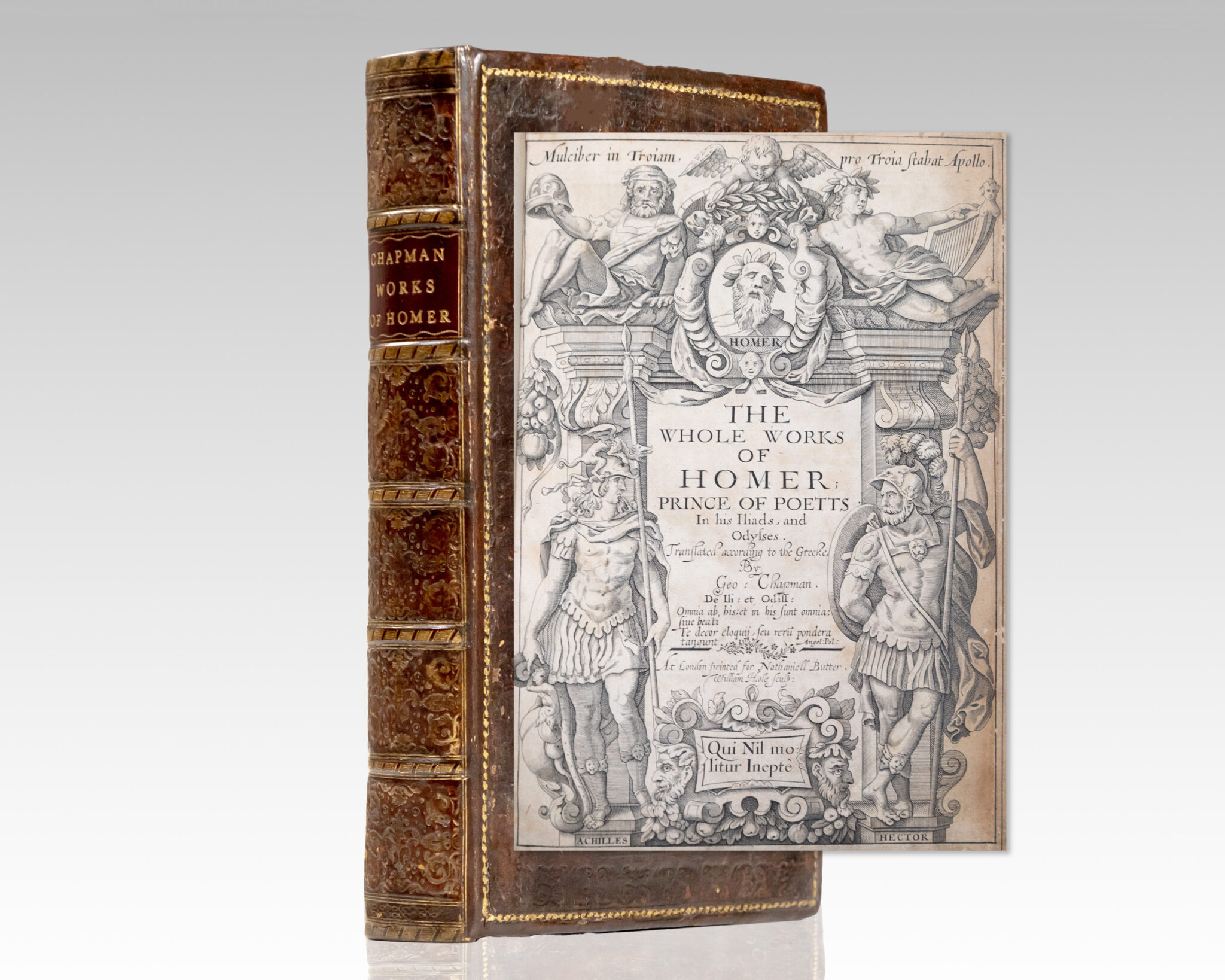
The Whole Works of Homer — George Chapman’s first complete English translation, c.1616 (STC 13624).
The first complete English Homer was the labor of one man’s lifetime. Beginning in 1598, George Chapman spent decades rendering the epics into Early Modern English, publishing the Odysseys in two parts between 1614 and 1615 and gathering everything into The Whole Works of Homer around 1616. Chapman did not attempt a literal version; as the Oxford Encyclopedia of British Literature observes, he “personalized and appropriated his epic source.” Facing the unbridgeable gap between Greek quantity and English stress, he abandoned rigid metrical conformity altogether — working in rhyming couplets and other forms, taking bold interpretive liberties, and infusing the narrative with his own philosophical preoccupations. The result is a Jacobean Homer that is at once translation and original composition: Homer made to speak in the voice of Stuart England.
The project was sustained by the patronage of Prince Henry, eldest son of James I, and the finished work became bound up with tragedy — Henry died of typhoid at just eighteen, and the volume carries an engraved memorial page with a verse epitaph, so that the book stands as a monument to both the ancient poet and Chapman’s lost patron and friend. Chapman’s approach — privileging vigor and readability over slavish fidelity — set the pattern for English Homeric translation for centuries; two hundred years later the young John Keats sat up all night over a borrowed copy and greeted the dawn with his sonnet “On First Looking into Chapman’s Homer,” likening the discovery to an astronomer sighting a new planet.
The 1510 Odissea — one of the earliest printed Latin translations of Homer’s Odyssey.
Before English readers had Chapman, Europe met Homer chiefly in Latin, the shared language of Renaissance scholarship. This 1510 Odissea is one of the earliest printed Latin translations of the Odyssey, rendered from the Greek by the Roman Hellenic scholar Raphael of Volterra. A quarto in contemporary vellum with woodcut titles, from the library of the American bibliophile Robert R. Dearden, Jr., it represents the crucial first stage in Homer’s westward journey — the bridge by which the ancient poem crossed from Greek antiquity into the modern European imagination, and the tradition of learned translation that English poets like Chapman would inherit.
The first editions of Pope’s Iliad and Odyssey — eleven volumes in contemporary calf.
Where Chapman appropriated, Alexander Pope refined. A century later, Pope answered the metrical problem with the heroic couplet — rhymed iambic pentameter polished to a dazzling sheen — and though purists grumbled (the classicist Richard Bentley reportedly told him, “It is a very pretty poem, Mr. Pope, but you must not call it Homer”), his version became the most celebrated and profitable English Homer of the eighteenth century, making him the first English poet able to live on the proceeds of his verse. These are the first editions of his Iliad (1715–1720) and Odyssey (1725–1726), eleven quarto volumes uniformly bound in full contemporary calf — the neoclassical Homer that shaped English taste for a hundred years.
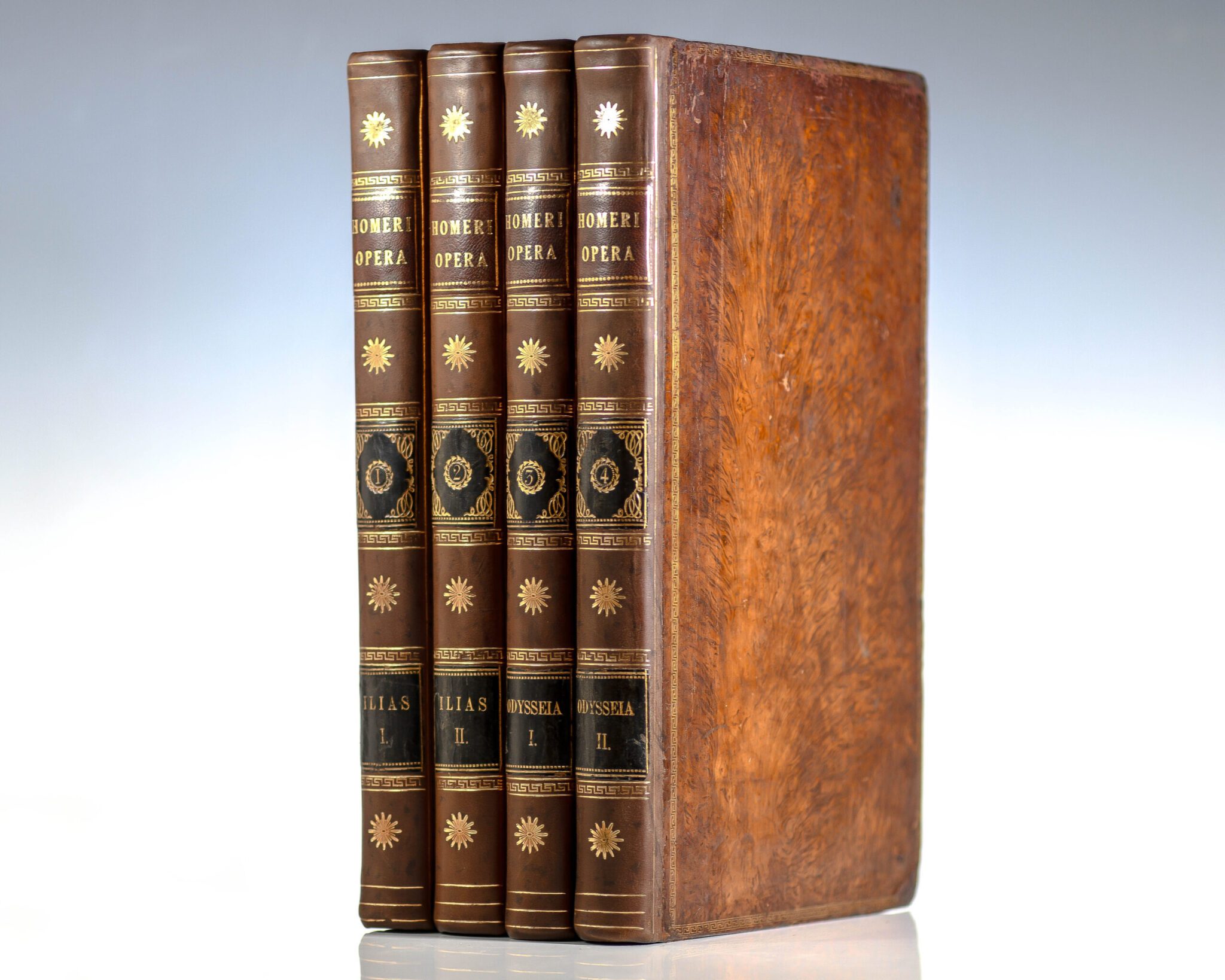
The first Foulis edition of Homer — four folio volumes printed in Greek at Glasgow.
Not every landmark is a translation; some return to the source itself. Printed in Greek at Glasgow by Robert and Andrew Foulis — the finest printers Scotland ever produced — the Foulis Homeri Opera is widely regarded as the typographic masterpiece of the Foulis Press and one of the most beautiful editions of Homer ever made. Bound in full tree calf with Greek-key ruling gilt to the spines, these four folio volumes give the reader not another poet’s Homer but Homer’s own words, set in type as an object worthy of the text — a reminder that behind every translation stands the untranslatable Greek.
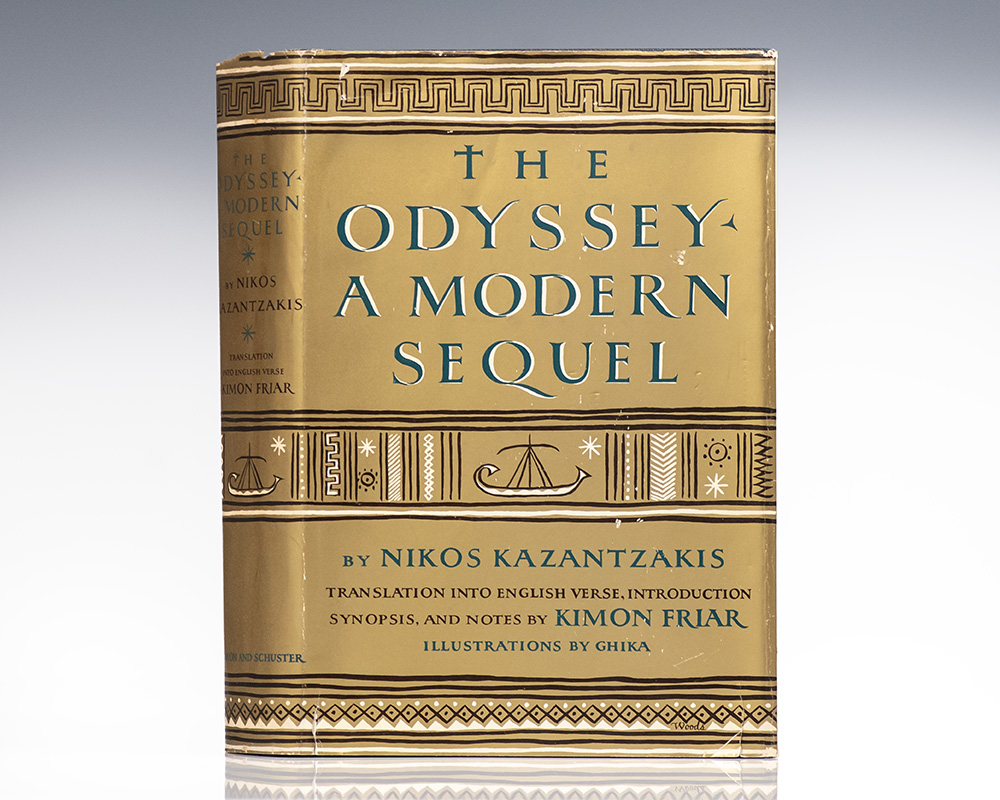
The 1938 first edition of Kazantzakis’s Odyssey: A Modern Sequel — one of 277 signed copies.
Some heirs of Homer did not translate him but continued him. In his monumental Odyssey: A Modern Sequel, the Greek master Nikos Kazantzakis takes up the tale where Homer set it down, sending his restless hero on one last voyage across a vast poem of 33,333 lines — Homer not as a text to be rendered but as a living wellspring of new creation. We offer the 1938 first edition, a folio, one of just 277 copies signed by Kazantzakis, alongside the 1958 first edition in English in Kimon Friar’s celebrated translation with illustrations by Ghika.
The 1958 first edition in English, translated by Kimon Friar.
Kazantzakis reached the English-speaking world largely in the 1950s and 1960s, when translations of Zorba the Greek, The Last Temptation of Christ, and Freedom or Death carried his name far beyond Greece and made him a perennial contender for the Nobel Prize. None of those undertakings, however, rivaled the labor of Englishing the Odyssey itself: the American poet Kimon Friar devoted years to the task, working in close collaboration with Kazantzakis to carry the poem’s vast seventeen-syllable Greek line into English. Published in 1958 with illustrations by the Greek painter Ghika, Friar’s translation is regarded as a monumental achievement in its own right — the work that finally opened Kazantzakis’s modern Odyssey to readers around the world.
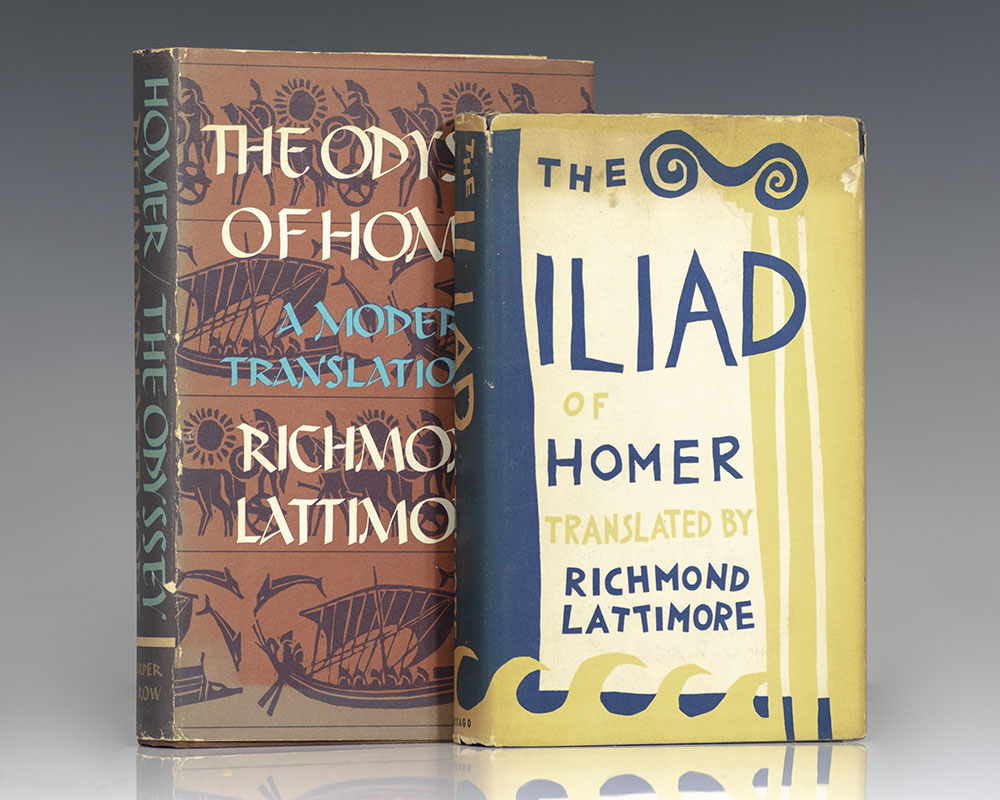
The modern age brought a new answer to the old problem — not appropriation but fidelity. Richmond Lattimore did what Chapman would not, holding faithfully to the shape and dignity of the Greek and forging a long, six-beat English line that echoes the hexameter itself. His Iliad (1951) and Odyssey (1967) were hailed by William Arrowsmith as “the finest translation of Homer ever made into the English language.” These are the first editions of both volumes — the scholar’s Homer, the one that comes closest to letting the Greek speak in English dress.
First editions of Fagles’s Iliad and Odyssey, both signed by the translator.
If Lattimore is the scholar’s Homer, Robert Fagles is the reader’s. His vigorous, dramatic, deeply human translations — the Homer most widely read today — strike a balance the whole tradition had been seeking: faithful to the Greek yet alive as English poetry. Offered here are the first editions of both his Iliad (1990) and Odyssey (1996), each signed by Fagles and introduced by the great classicist Bernard Knox — the culmination of four centuries of Englishing Homer that Chapman began.
From Chapman’s Jacobean couplets to the plain grandeur of Lattimore and Fagles, each of these editions is a different answer to the same impossible question: how to make a poet who sang in a meter English cannot reproduce live again on the English page. Together they trace Homer’s passage down the centuries — proof that the oldest stories in the Western canon have never stopped finding new form. Each copy is available at Raptis Rare Books.
When people picture the Palm Beach lifestyle, they think of pristine beaches, luxury cars, and premier real estate. Tucked along the world-famous Worth Avenue, however, is a quieter…
A book signed by its author is more valuable than the same book unsigned. Most collectors accept this as axiomatic. What fewer collectors fully appreciate is that the…
Join our growing list of satisfied clients who have leveraged
our multi-cloud and hybrid cloud strategies to achieve greater
agility and efficiency in their operations.