Signed, Inscribed & Dedicated: Understanding the Value of Association Copies.
A book signed by its author is more valuable than the same book unsigned. Most collectors accept this as axiomatic. What fewer collectors fully appreciate is that the signed copy and the association copy are not merely different degrees of the same thing — they are categorically different objects, governed by different principles of value, and capable of commanding premiums that place them in an entirely separate market tier.
Understanding the distinction, and what drives it, is one of the most rewarding areas of bibliographic knowledge a collector can develop.
Signed, Inscribed, Presentation, Association: The Hierarchy Defined
These four terms are used with varying precision in the trade, and the distinctions matter.
A signed copy carries the author’s signature alone, typically on the title page or front free endpaper, with no further inscription. It confirms the author’s hand was on the book. It adds value. It tells no story.
An inscribed copy carries a signature with a reference to a recipient — “To John, with warm regards” — establishing that the book passed directly from author to a named individual. The inscription elevates the copy by documenting a human transaction. Whether that transaction is significant depends entirely on who John is.
A presentation copy is a more specific term: a book given by the author to a recipient, typically with an inscription making the gift explicit. Presentation copies reserved for family members, close colleagues, or figures of independent historical significance represent the most intimate category of author-signed material and are among the most actively sought objects in the field.
An association copy is the broadest and in many ways the most intellectually interesting category. It encompasses any book connected in a meaningful, documentable way to its author, its subject, or a significant figure in its history — whether through inscription, ownership, annotation, or provenance. The connection is what confers value, not the inscription alone. A book from a president’s personal library, annotated in his hand, is an association copy of the highest order regardless of whether he wrote a word of it.
What Drives the Premium
The value of an association copy above the signed copy rests on a single principle: narrative. The more compelling, more historically significant, and more fully documented the story a copy tells, the more it is worth.
Three variables govern this premium in practice.
The first is the identity of the recipient or previous owner. A copy inscribed to a close friend of the author carries more weight than one inscribed to an unknown admirer. A copy inscribed to a fellow writer of comparable stature carries more weight still. A copy inscribed to the person to whom the book is dedicated — the dedication copy, one of the rarest and most sought categories in the field — represents the ultimate intersection of bibliographic significance and personal history.
The second is the content of the inscription itself. Length, specificity, and personal warmth all amplify value. An inscription that illuminates the author’s relationship to the recipient, reflects on the work itself, or documents a specific moment in literary or intellectual history is worth considerably more than a perfunctory signature and date.
The third is provenance documentation. An association copy whose chain of ownership is fully traceable — from the author’s hand to the present — is worth more than one whose story requires inference. The table from the Morris household at which Abraham Lincoln sat to inscribe a first edition of the Lincoln-Douglas Debates, accompanying that very copy, is not a sentimental accessory. It is provenance documentation of the most concrete kind, transforming an already remarkable object into something unprecedented.
Association Copies We Have Had the Privilege of Offering
First edition inscribed by F. Scott Fitzgerald to Newman Smith, in the first-issue dust jacket.
Among the most significant association copies we have ever offered — and the centrepiece of our recent centenary celebration of the novel’s publication — is a first edition, first printing inscribed by Fitzgerald in the year of publication to Zelda’s sister and her husband Newman Smith, in the exceptionally rare first issue dust jacket. This is the category of association copy the market for twentieth-century American literature prizes most highly: a presentation copy from the year of publication, to a recipient with a documentable personal connection to the author, in the finest possible physical state.
First edition presentation copy inscribed by J.R.R. Tolkien, with the original dust jacket.
Among the handful of presentation copies Tolkien reserved for family, colleagues, and close friends from the first printing of 1,500 copies, we have offered a first edition inscribed by Tolkien on the flyleaf — one of only a handful of such copies known to have been set aside for personal presentation. The original dust jacket, designed by Tolkien himself and present in our copy, places it in a category of exceptional rarity even among Tolkien presentation copies.
First edition of the Lincoln-Douglas Debates, inscribed by Abraham Lincoln to Martin S. Morris.
The only known first edition of the Lincoln-Douglas Debates inscribed by Abraham Lincoln — to his long-time political supporter and friend Martin S. Morris — and accompanied by the table from the Morris household at which Lincoln sat to sign the book. An inscription in Lincoln’s pencil hand, with physical provenance that no other copy can claim. It is precisely the kind of object — unrepeatable, historically irreplaceable — that defines the upper reaches of the field.
The personal copy of Benjamin Graham, inscribed by him to his nephew.
A first edition of Graham and Dodd’s foundational work on value investing — described by successive generations of investors as the bible of modern financial analysis and the text from which Warren Buffett’s entire philosophy of investing derives — Graham’s personal copy, inscribed by him to his nephew. The conjunction of the author’s own copy with a family inscription transforms an already scarce first edition into an object of unique biographical and intellectual significance. For the collector whose interests span financial history as well as literature, there is no more resonant association copy in the economics field.
First edition, first issue inscribed by Ayn Rand to Jack L. Warner.
A first edition, first issue inscribed by Rand to Jack L. Warner — co-founder and president of Warner Bros. Studios — with the inscription reading in full: “Thank you for your courage and for a magnificent picture — with my profound gratitude — Ayn Rand. January 7, 1949.” The story behind it is precisely the kind of context that elevates an association copy to an entirely different level of significance. Rand had sold the film rights to Warner with the contractual provision that her screenplay would be unalterable; when the director sought changes, Warner honoured the contract and supported the author. The inscription, written six months before the film’s release, is Rand’s direct acknowledgement of that act. Author, studio head, and a specific documented moment of creative integrity — all contained in a single object.
First edition inscribed by John F. Kennedy to J. Edgar Hoover.
A first edition of Kennedy’s Pulitzer Prize-winning work, inscribed by the author to J. Edgar Hoover — “To J. Edgar Hoover — a public servant of the highest courage — with the admiration of the author — John Kennedy.” The recipient served as Director of the FBI for nearly forty-eight years, and his relationship with the Kennedy family was a study in the complexity of power and alliance. Given that their relationship became notoriously turbulent in later years, this inscription — written in admiration shortly after the book’s publication in 1956 — carries a biographical charge that only deepens in retrospect. It is one of the finest association copies connecting two of the most consequential figures in twentieth-century American political history.
First edition inscribed by Ian Fleming to Una Trueblood.
A first edition inscribed by Fleming to Una Trueblood — his personal secretary throughout the 1950s — with the characteristically wry inscription: “To Una, who again wrote the whole thing!” What makes this copy exceptional is the depth of the association: Una was not merely a professional colleague but a figure whose surname Fleming directly appropriated for the Bond character Mary Trueblood in Dr. No. She typed up every manuscript Fleming sent from Goldeneye, his Jamaican retreat, and was as close to the creative process of the Bond novels as anyone other than Fleming himself. It is one of the finest association copies imaginable for this title — a book inscribed to the woman whose name Fleming put into it.
First edition inscribed by James Joyce to Lewis Galantière.
A presentation copy of Joyce’s masterpiece — universally acknowledged as the most influential work of literary modernism — in its original blue wrappers, inscribed by Joyce to Lewis Galantière. Among the earliest obtainable presentation copies of Ulysses, at a period when Joyce’s stature was already fully established and the significance of the gesture fully understood by both author and recipient.
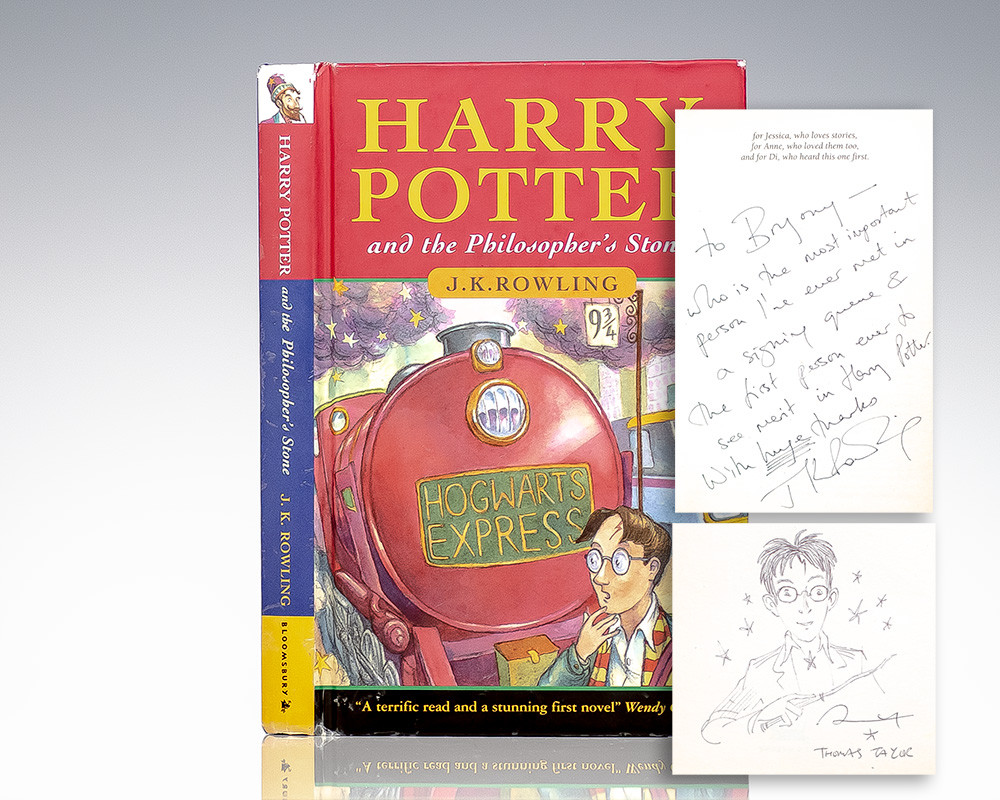
First edition inscribed by J.K. Rowling to Bryony Evens, with a drawing by illustrator Thomas Taylor.
The most important association copy of the most valuable modern first edition — inscribed by Rowling to Bryony Evens, her literary agent, and additionally signed by illustrator Thomas Taylor with an original drawing of Harry Potter. Bryony Evens was the person who first championed the manuscript and whose advocacy was directly responsible for the book’s publication. This is dedication copy territory: a book given to the person most responsible for its existence in the world.
Collecting Association Copies: A Practical Framework
The collector approaching this category for the first time should be guided by two principles above all others.
The first is that the story matters more than the signature. A lengthy, specific, personally revealing inscription to an unknown recipient is of less value than a brief inscription to a figure whose connection to the author is documentable and significant. Research the recipient before you assess the premium.
The second is that documentation is everything. The value of an association copy rests entirely on the credibility of its story. A provenance that can be traced — through bookseller records, auction catalogues, family correspondence, or the kind of accompanying physical evidence represented by Lincoln’s table — is worth considerably more than one that rests on assertion alone.
Every association copy we offer has been assessed against these standards. The inscriptions are genuine, the recipients identified wherever possible, and the provenance documented to
the fullest extent the historical record allows.
Browse our current inventory of signed, inscribed, and association copies, or contact us to discuss a specific collecting interest in this area.
It is one of the strangest stories in the history of modern literature. A novel rejected by every commercial publisher who saw it. A novel prosecuted for obscenity…
It is one of the great near-misses in modern publishing history. In 1953 a forty-one-year-old schoolmaster named William Golding finished a short, strange novel about a group of…
There is a particular category of rare book that transcends the ordinary parameters of the collecting field. These are not simply early printings of significant texts they are…
Join our growing list of satisfied clients who have leveraged
our multi-cloud and hybrid cloud strategies to achieve greater
agility and efficiency in their operations.