

THOREAU, Henry David.
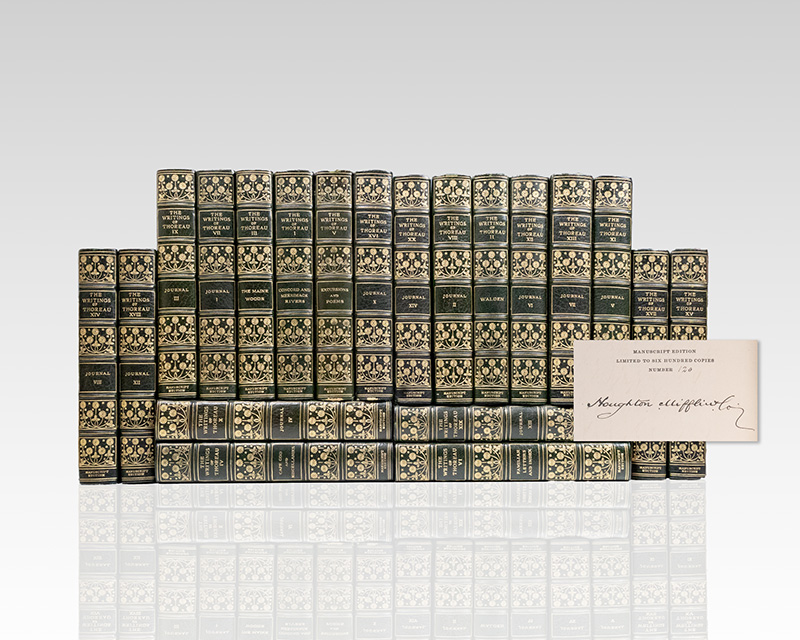
The Manuscript Edition of The Writings of Henry David Thoreau.
Boston: Houghton Mifflin and Company, 1906.
$20,000.00
In Stock
Item Number: RRB-152359
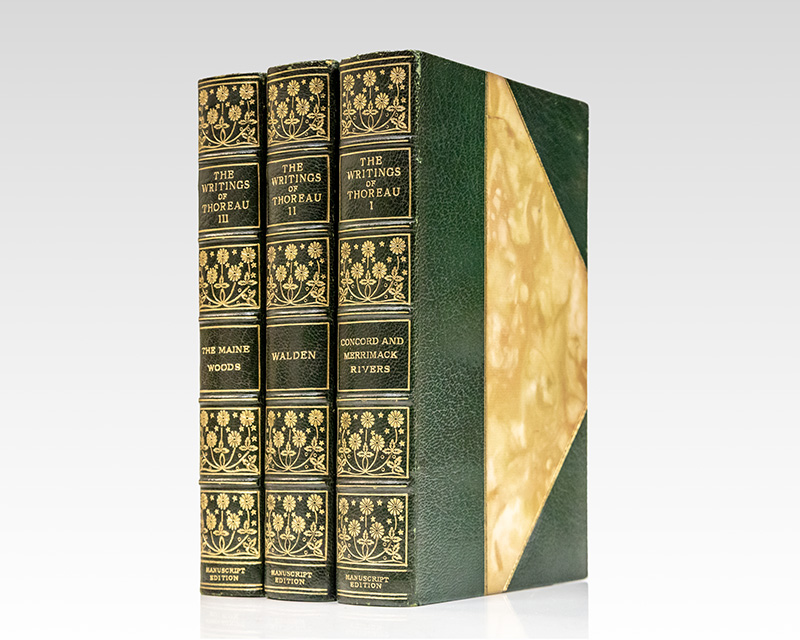
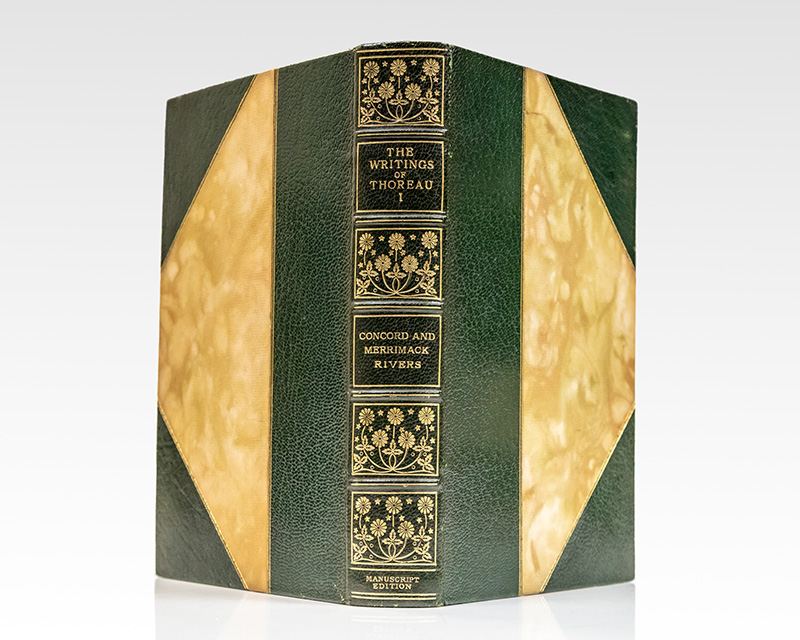
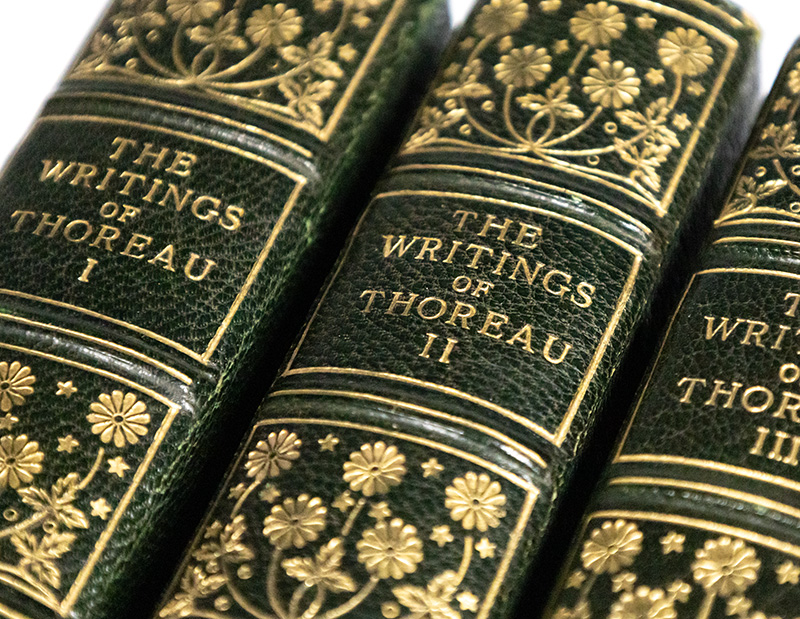
The Manuscript Edition of The Writings of Henry David Thoreau; In the Original Publisher's Turn-of-the-Twentieth-Century Binding by the Harcourt Bindery
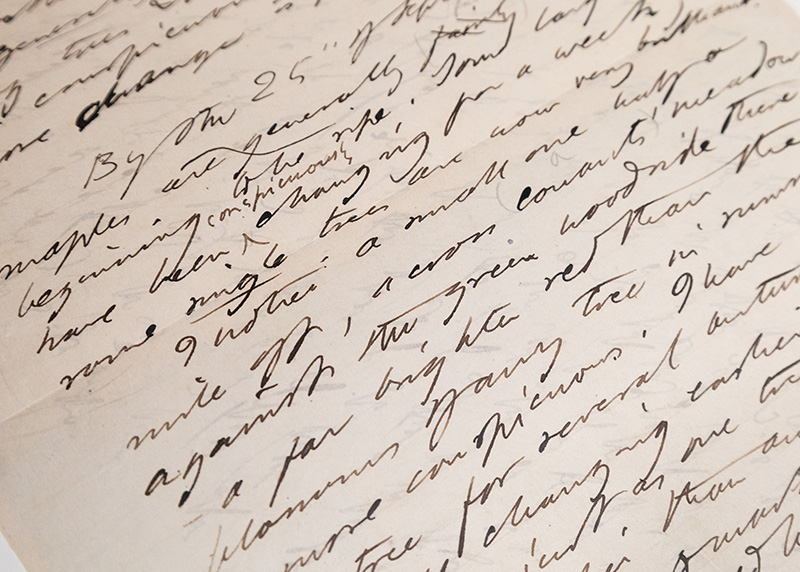
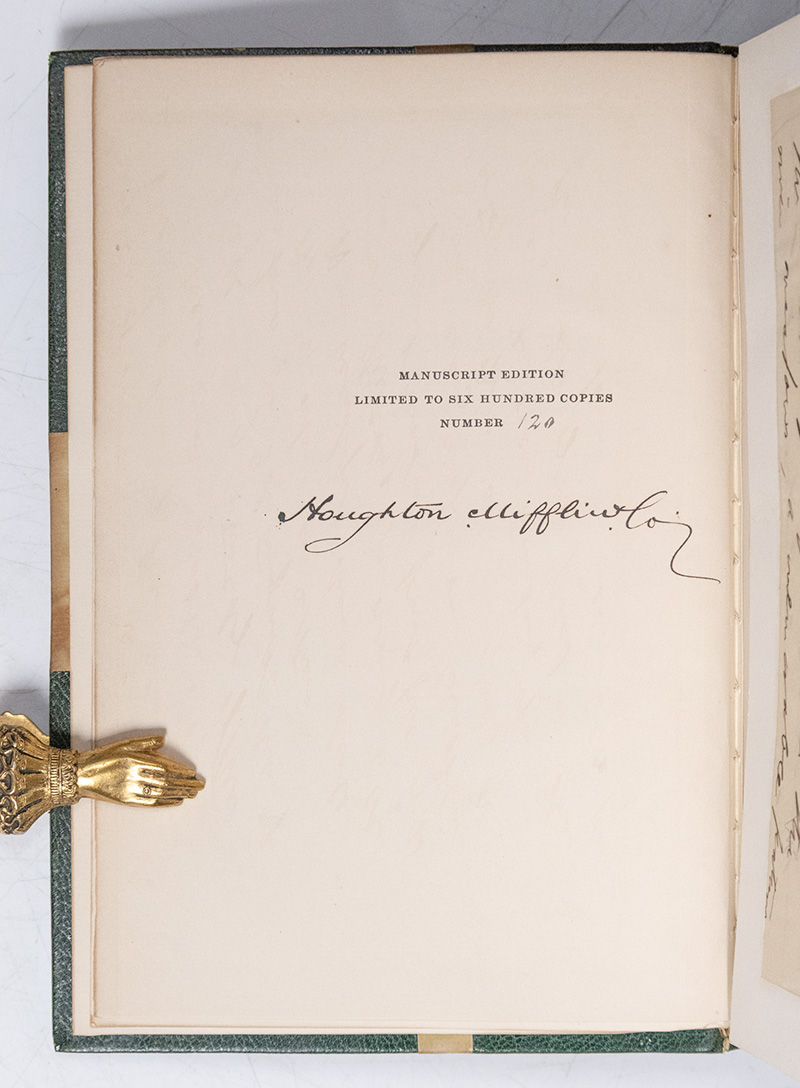
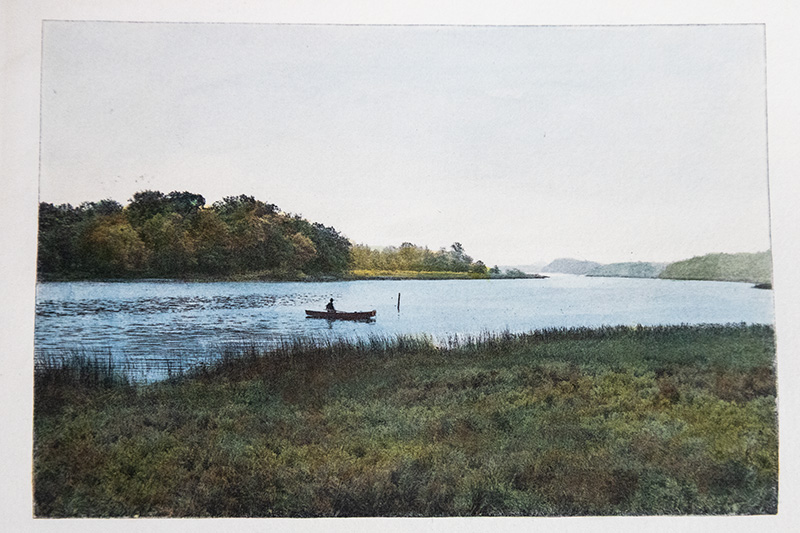
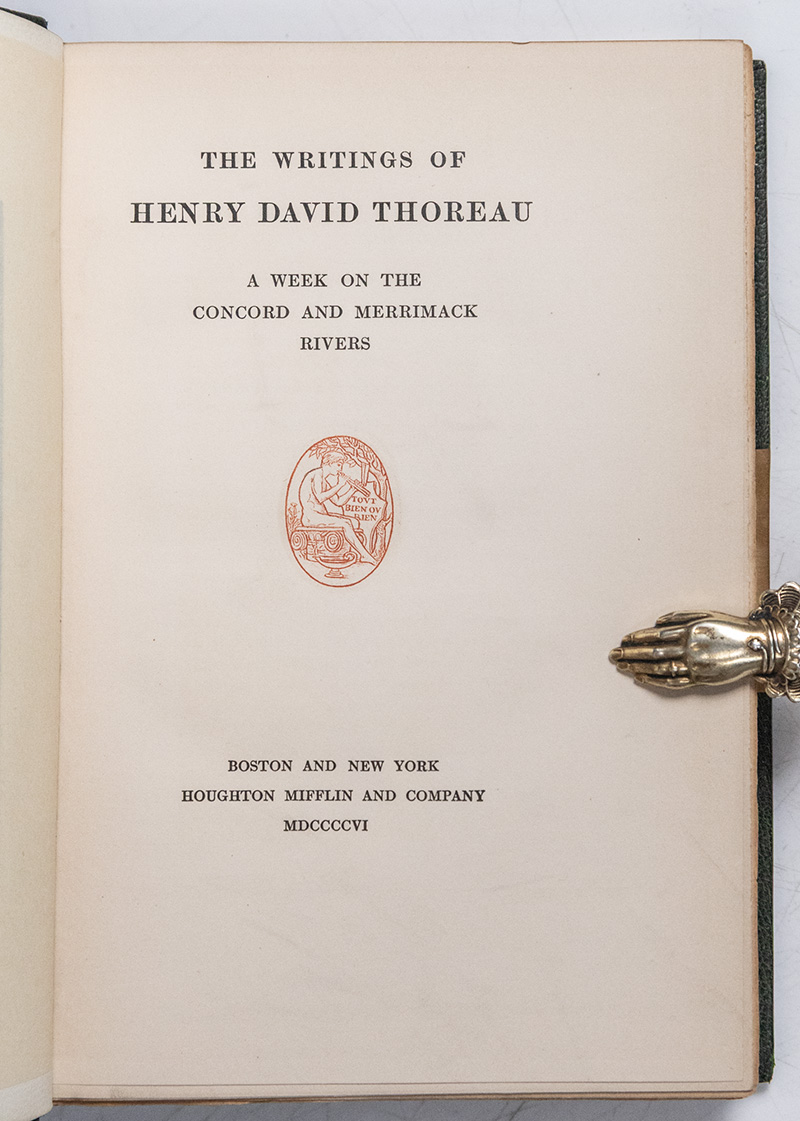
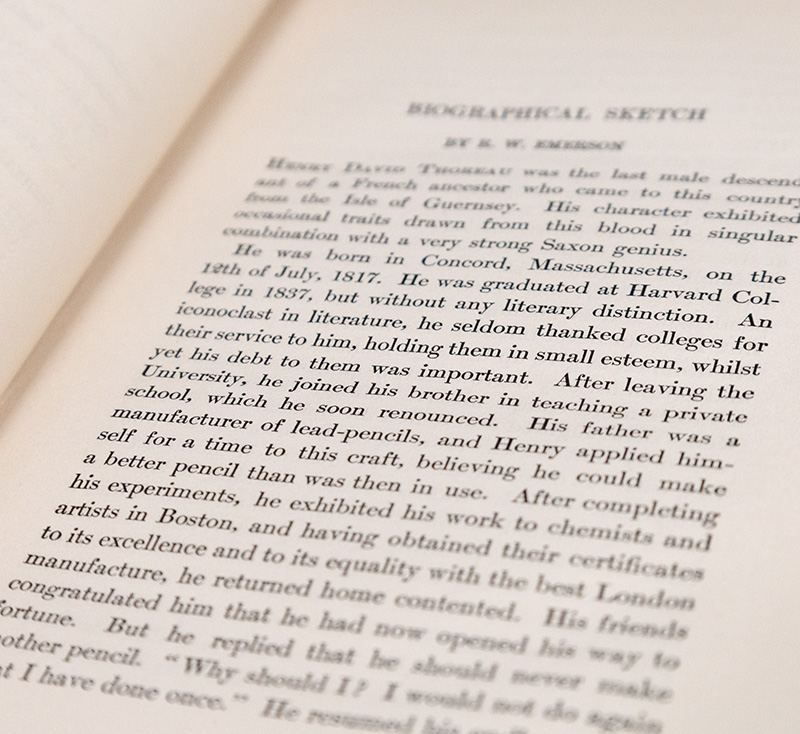
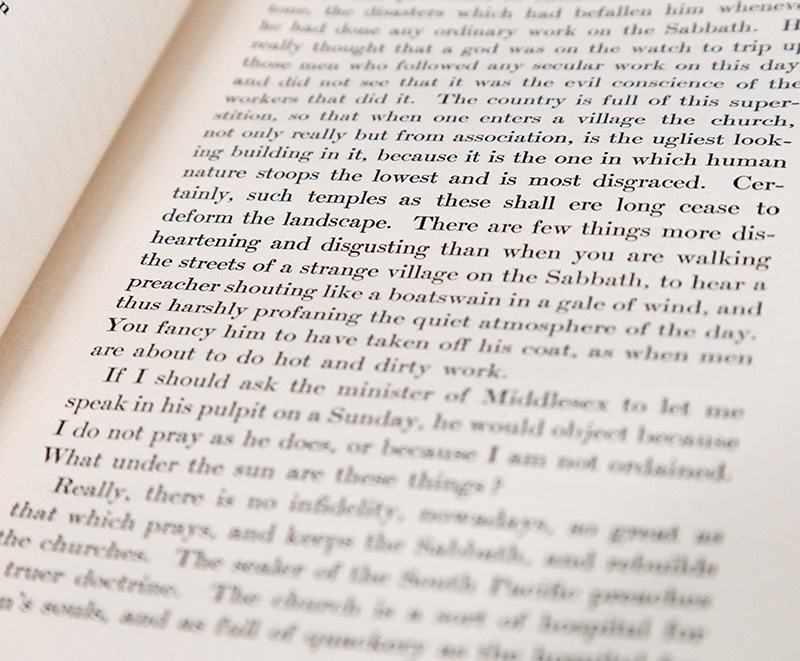
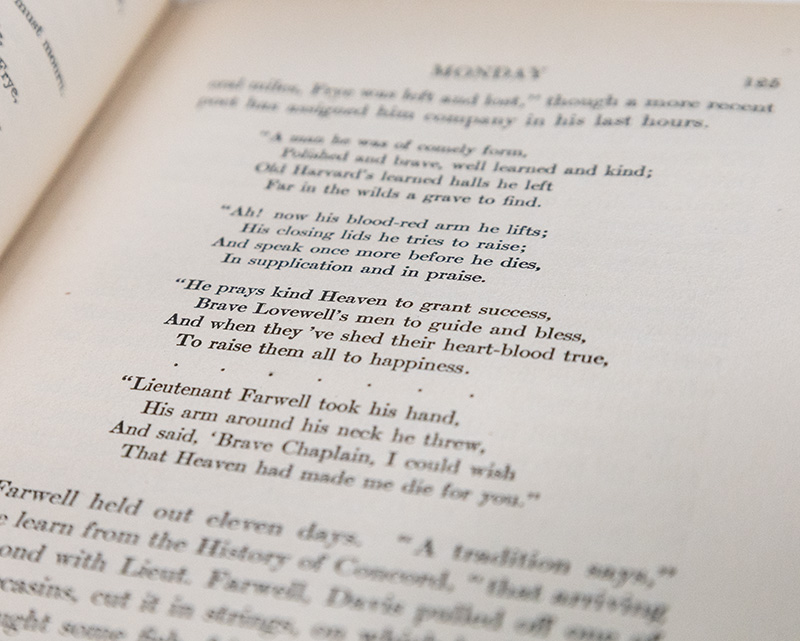
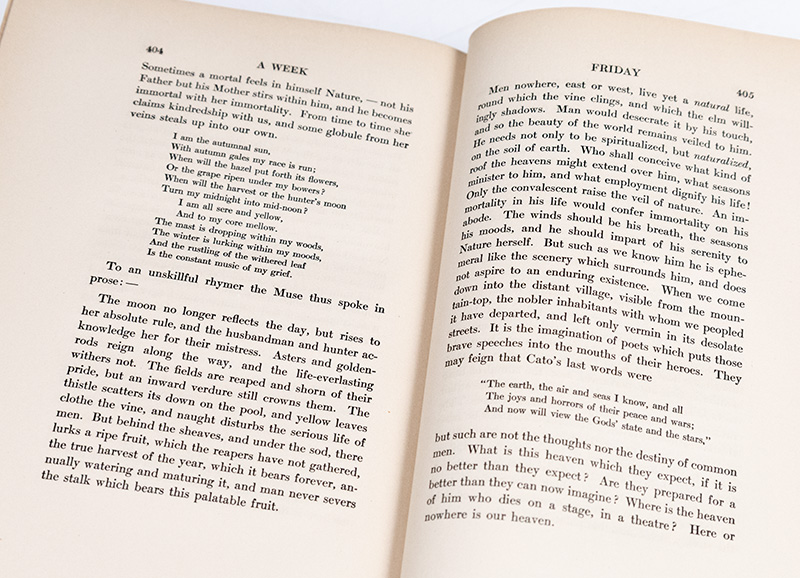
The manuscript edition of the writings of Henry David Thoreau with an original folding double-sided manuscript fragment from Thoreau's journal tipped in to Vol. I. Octavo, 20 volumes, original publisher's three quarter green levant morocco over Morris paper boards, bound for Houghton Mifflin by the Harcourt Bindery with gilt titles and elaborate botanical gilt tooling to the spine in six compartments within raised gilt bands, top edge gilt, Morris paper endpapers, ribbons bound in, frontispieces and photogravure plates by Herbert W. Gleason, each volume with two frontispieces in colour and a coloured carbon photograph of a flower, title page vignettes, titles and half-titles printed in red and black, numerous photogravure illustrations, double-sided manuscript sheet from Thoreau's journal tipped in to Vol. I. One of six hundred numbered copies signed by the publisher in Vol. I, this is number 120. The double-sided page manuscript fragment comprises 57 lines from "Autumnal Tints," in altered form, published in the Atlantic Monthly, October 1862, and collected in Excursions the following year, 28 on the recto which reads in full: "…— or varying from green through dull crimson to dull scarlet.— Also, Elms are now commonly yellowed — a brownish yellow — and many rather thin-leaved, some indeed more than half fallen, in a dry year.— But, generally speaking, it is only young trees & bushes that are yet conspicuously changed — or whose change is generally noticed. By the 25th of September the red maples are generally fairly under way — beginning to be ripe. Some large ones have been conspicuously changing for a week, & some single trees are now very brilliant. I noticed a small one, half a mile off, across Conant's meadow, against the green woodside there, — a far brighter red than the blossoms of any tree in summer, & more conspicuous. I have observed this tree for several autumns, invariably changing earlier than its fellows, just as one tree ripens its fruit earlier than another. It might serve to mark the season, perhaps. I should be sorry if that tree were cut down..." and 29 on the verso which reads in full: "Small maples in low grounds have fairly begun to burn. (They vary from scarlet to crimson.) Sometimes you will see a great many small ones in a swamp turned quite crimson when all other trees around are still perfectly green, & the former appear so much the brighter for it. They take you by surprise as you are going by on one side, perhaps, across the fields, as if there were some fair held there, or something else going on there, which you had not heard of. Indeed it looks like training day in the meadows & swamps. They have run up their colors. These burning bushes stand thus chiefly along the edge of the meadows, or I distinguish them afar on the hill-sides here & there. How beautiful when a whole tree on the edge of a swamp is like one great scarlet fruit, full of ripe juices, every leaf from lowest limb to topmost spire all a-glow; or when it is seen standing afar in the midst of the flood on the river meadows, a memorable feature..." BAL 20145; Borst B3. In near fine condition. A splendid turn of the 20th century Harcourt binding. Founded over a century ago in 1900, the Harcourt Bindery is the oldest and largest traditional bindery in America exclusively devoted to fine traditional leather bookbinding by hand.
Henry David Thoreau was a central figure of American Transcendentalism and one of the most influential writers the country has produced. He is best remembered for Walden, his account of two years spent living simply in a cabin beside Walden Pond, and for the essay “Civil Disobedience” (first published as “Resistance to Civil Government”), a defense of the individual’s right to withhold obedience from an unjust state. A tireless observer of the natural world, Thoreau filled more than twenty volumes with books, essays, poetry, and a vast journal, and his writings on natural history anticipated the concerns of ecology and environmental history, helping to lay the foundations of modern environmentalism. His prose unites precise observation of nature with personal reflection, pointed moral conviction, and a dry Yankee attention to practical detail. He was preoccupied throughout his life with endurance in the face of hostile elements, historical change, and natural decay, and with stripping away waste and illusion to discover life’s true essential needs. A lifelong abolitionist, he denounced the Fugitive Slave Law and defended John Brown, and his philosophy of nonviolent resistance would later shape the thought and action of such figures as Leo Tolstoy, Mahatma Gandhi, and Martin Luther King, Jr.
The Manuscript Edition of The Writings of Henry David Thoreau.
$20,000.00
In Stock
