


ISAACSON, Walter [Vint Cerf; Leonard Kleinrock; Robert Kahn; Tim Berners-Lee; Linus Torvalds].
The Innovators: How a Group of Hackers, Geniuses, and Geeks Created the Digital Revolution.
New York: Simon & Schuster, 2014.
$6,500.00
In Stock
Item Number: RRB-152132
+$500
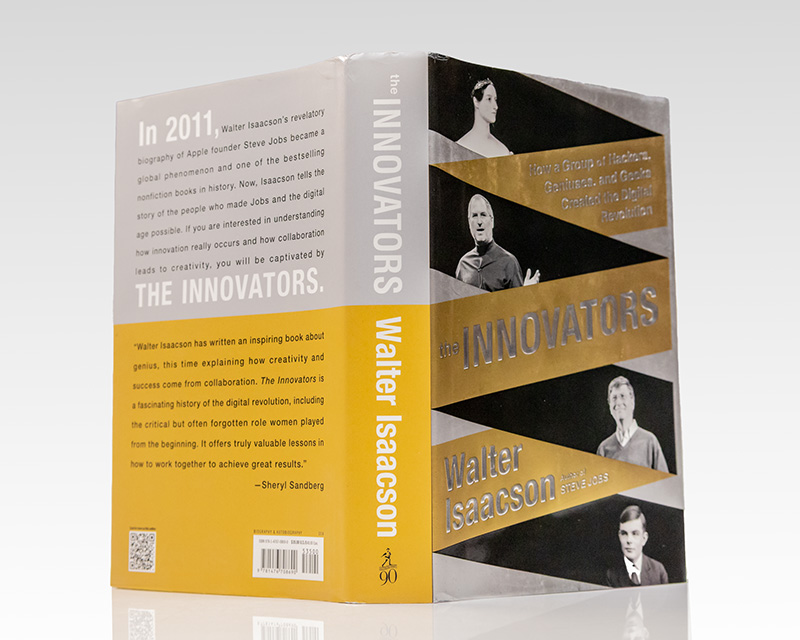
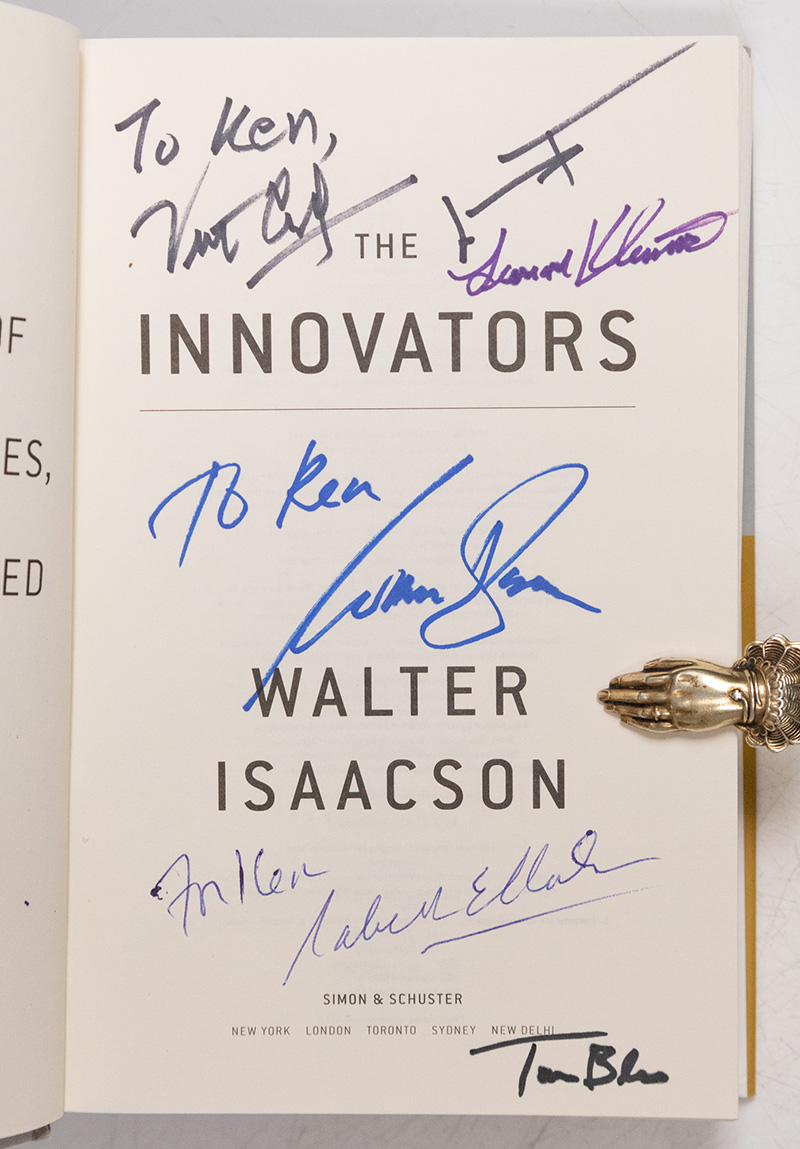
First Edition of The Innovators; Signed by Walter Isaacson, Internet Pioneers Vint Cerf, Robert Kahn, Leonard Kleinrock, Tim Berners-Lee, and Linus Torvalds
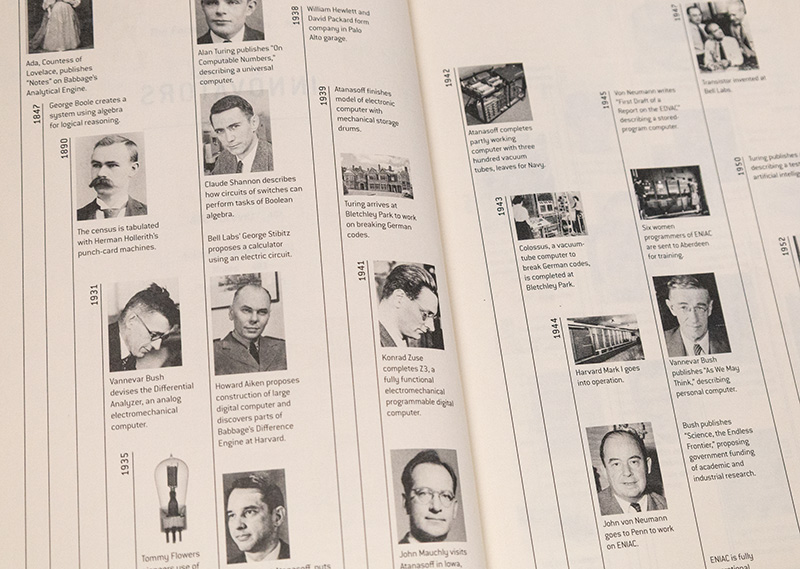
First edition of this sweeping history of the computer and the Internet, signed by Isaacson and several legendary internet pioneers. Octavo, original publisher's half-cloth, circuit board endpapers, illustrated throughout. Presentation copy, inscribed on the title page by Walter Isaacson, Vint Cerf, and Robert Kahn, "To Ken." Boldly signed on the title page by Leonard Kleinrock, Tim Berners-Lee, and Linus Torvalds. Fine in a fine dust jacket. Jacket design by Pete Garceau.
Vint Cerf, Leonard Kleinrock, Robert Kahn, Tim Berners-Lee, and Linus Torvalds collectively constitute the most consequential group of technologists in the history of the modern internet, their individual contributions forming the successive layers of infrastructure, protocol, application, and software upon which virtually every aspect of contemporary digital life depends. Kleinrock, whose doctoral dissertation at MIT in 1962 developed the mathematical theory of packet switching that made digital networks possible, laid the theoretical foundation upon which all subsequent work rested, and his UCLA laboratory transmitted the first message over ARPANET on October 29, 1969. Cerf and Kahn, working together at DARPA in the early 1970s, co-designed the Transmission Control Protocol and Internet Protocol, TCP/IP, the fundamental communication standard that enabled disparate computer networks to exchange data seamlessly and that remains the backbone of the global internet to this day, earning both men the Presidential Medal of Freedom and the Turing Award, widely regarded as the Nobel Prize of computing. Berners-Lee, a British computer scientist working at CERN in Geneva, built upon this foundation in 1989 and 1990 to invent the World Wide Web, creating the system of hypertext markup language, uniform resource locators, and hypertext transfer protocol that transformed the internet from a specialist research network into the universal information environment that billions of people now inhabit, earning him a knighthood, the Turing Award, and recognition by Time magazine as one of the hundred most important people of the twentieth century. Torvalds, a Finnish software engineer then studying at the University of Helsinki, released the first version of the Linux kernel in 1991, launching a free and open-source operating system that now powers the overwhelming majority of the world's servers, supercomputers, smartphones through its Android derivative, and the cloud infrastructure upon which the modern internet runs, making him arguably the single most impactful software developer in history despite operating entirely outside the commercial frameworks that produced his contemporaries' achievements.
The Innovators: How a Group of Hackers, Geniuses, and Geeks Created the Digital Revolution (2014) is a landmark work of popular intellectual history by Walter Isaacson, Professor of History at Tulane University and recipient of the National Humanities Medal, whose previous biographical subjects — Benjamin Franklin, Albert Einstein, Steve Jobs, and Leonardo da Vinci — had each been treated as solitary geniuses, making this departure into collective biography both a natural culmination and a deliberate corrective. Spanning the period from the 1830s to the present and encompassing the development of the analytical engine, the electromechanical computer, the personal computer, and the internet, the book advances the central argument that innovation comes from teams more often than from the lightbulb moments of lone geniuses and that this was true of every era of creative ferment — a thesis Isaacson substantiates through portraits of figures including Ada Lovelace, Alan Turing, John von Neumann, Vannevar Bush, J.C.R. Licklider, Doug Engelbart, Robert Noyce, Vint Cerf, Robert Kahn, Tim Berners-Lee, Bill Gates, Steve Wozniak, and Larry Page. The book was named a Best Book of 2014 by the New York Times, the Washington Post, the Financial Times, Kirkus, Amazon, NPR, Bloomberg, the Wall Street Journal, and Forbes, and was longlisted for the National Book Award, with The Atlantic calling it riveting, propulsive, and at times deeply moving, and the New York Times describing it as a sweeping and surprisingly tenderhearted history of the digital age.
The Innovators: How a Group of Hackers, Geniuses, and Geeks Created the Digital Revolution.
$6,500.00
In Stock