

LEWIS, Sinclair.
It Can't Happen Here.
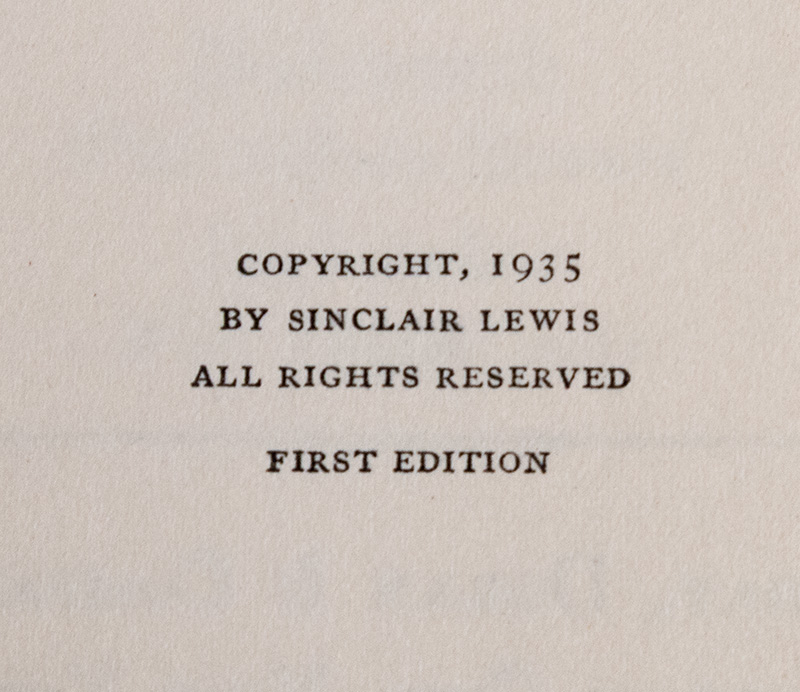
Garden City, NY: Doubleday, Doran & Company, 1935.
$4,800.00
In Stock
Item Number: RRB-151701
+$500
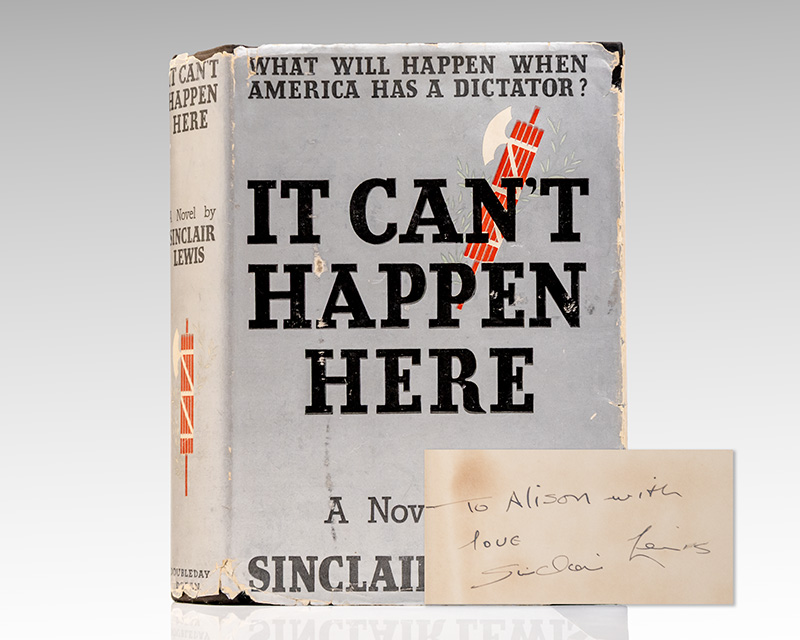
First Edition of Sinclair Lewis' It Can't Happen Here; Inscribed by Him to Fellow Novelist Alison Lurie and In the Uncommon Original Dust Jacket
First edition of Lewis' later masterpiece. Octavo, original cloth. Association copy, inscribed by the author on the front free endpaper to novelist Alison Lurie, "To Alison with love Sinclair Lewis." The recipient, Alison Lurie was a novelist, critic, and professor whose work occupied a distinctive niche in postwar literary culture — sharp, satirical, and quietly subversive beneath a surface of social comedy. A longtime member of the English faculty at Cornell University, she brought an academic's precision to her fiction without sacrificing readability, producing novels that dissected the manners and hypocrisies of educated American life with the cool detachment of an anthropologist. Her 1984 novel Foreign Affairs won the Pulitzer Prize for Fiction, cementing her reputation as one of the more astute chroniclers of class, gender, and the peculiar anxieties of intellectual society. Beyond her fiction, Lurie made significant contributions to the study of children's literature and the semiotics of dress — her 1981 work The Language of Clothes remains a touchstone in fashion studies. Though she was never quite absorbed into the canonical center of late-twentieth-century American letters, her influence on the comic novel of manners was considerable. Near fine in a very good dust jacket. An exceptional association.
In 1930, Sinclair Lewis became the first writer from the United States to receive the Nobel Prize in Literature, which was awarded "for his vigorous and graphic art of description and his ability to create, with wit and humor, new types of characters." His works are known for their insightful and critical views of American capitalism and materialism between the wars. He is also respected for his strong characterizations of modern working women. H. L. Mencken wrote of him, "[If] there was ever a novelist among us with an authentic call to the trade ... it is this red-haired tornado from the Minnesota wilds." It Can’t Happen Here is the only one of Sinclair Lewis’s later novels to match the power of Main Street, Babbitt, and Arrowsmith. A cautionary tale about the fragility of democracy, it is an alarming, eerily timeless look at how fascism could take hold in America. Written during the Great Depression, when the country was largely oblivious to Hitler’s aggression, it juxtaposes sharp political satire with the chillingly realistic rise of a president who becomes a dictator to save the nation from welfare cheats, sex, crime, and a liberal press. Called “a message to thinking Americans” by the Springfield Republican when it was published in 1935, It Can’t Happen Here is a shockingly prescient novel that remains as fresh and contemporary as today’s news.
It Can't Happen Here.
$4,800.00
In Stock
Other Books by this Author